Fifteen Americans made the third round. The drought still didn't break.
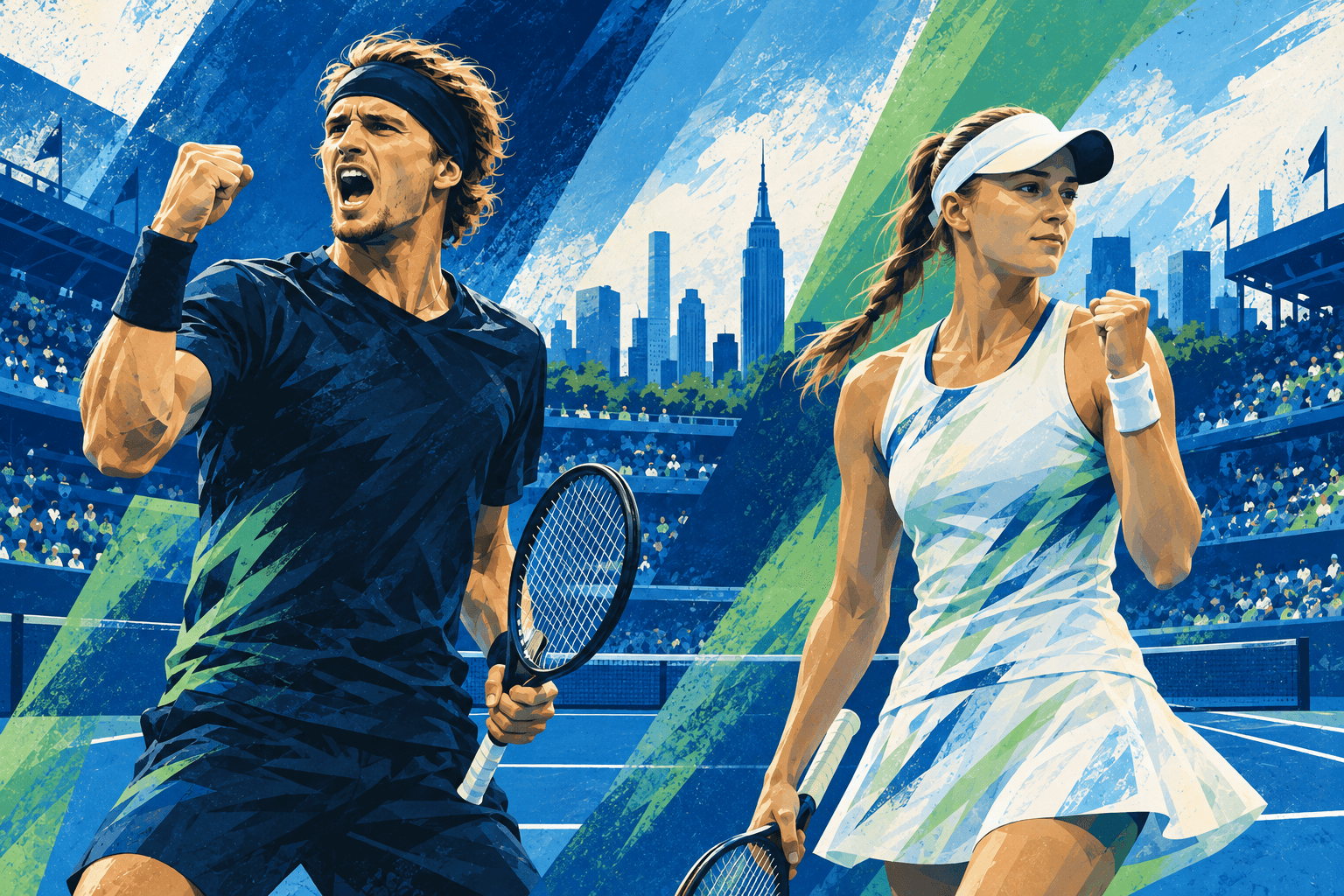
Fifteen American singles players reached the third round in New York, the most since 2002. Six reached the quarterfinals. One reached a final. And the trophies went to Germany and Kazakhstan. That gap — between the best American fortnight in a generation and an empty champion's photo — is the story of the 2026 US Open.
The results
Men's singles final, Sunday, September 13: Alexander Zverev def. Ben Shelton 6-3, 7-6(2), 5-7, 6-2.
Women's singles final, Saturday, September 12: Elena Rybakina def. Aryna Sabalenka 6-4, 5-7, 6-2.
Both champions collected $5.5 million from a purse that rose 20 percent year over year. Zverev has two majors now, both from this season. Rybakina has three, two of them from this season.
The men's draw came apart before it started
Jannik Sinner withdrew on August 21 with a right knee injury, the first time a reigning world No. 1 has missed the US Open. Then Novak Djokovic lost in the first round to Mariano Navone, ranked No. 49, by 7-6(5), 5-7, 4-6, 6-2, 6-1 across four hours and 36 minutes. It ended a 78-match first-round winning streak at majors and was his first opening-round loss at any major since the 2006 Australian Open; he had never before lost earlier than the third round in New York. Djokovic said in his post-match press conference that he had been struggling physically. It was the first major since the 2003 French Open with none of Djokovic, Roger Federer or Rafael Nadal in the second round.
From there the seeds kept going. Karen Khachanov, ranked No. 50 and unseeded, beat third seed Felix Auger-Aliassime in the second round and ran to the semifinals. Stefanos Tsitsipas beat 10th seed Arthur Fils in the first round and made the fourth round, his best US Open result. Taylor Fritz, a finalist here in 2024, lost in the third. By the time the semifinals were set, six of the men's top eight seeds were out.
Zverev was the exception, and only just. He became the first No. 1 seed to play five-setters in each of the first two rounds of a major — and then won 13 consecutive sets. Per Tennis Majors, he is the second man since 1973, after Federer in 2008, to reach multiple major finals in a season without meeting a top-20 opponent along the way.
The match everyone stayed up for
Shelton beat defending champion Carlos Alcaraz 6-7(5), 6-1, 6-3, 1-6, 7-6(10-7) in a quarterfinal that started after 11 p.m. and ended at 3:33 a.m. — the latest finish in tournament history, past the 2:50 a.m. mark set by Alcaraz and Sinner in 2022. Four hours, 28 minutes. Shelton had been 0-17 against top-three players before it, and he closed it with a 146 mph ace out wide. Alcaraz, playing his first event in more than four months after a wrist injury, saw a run of four straight major finals end.
Shelton then beat Frances Tiafoe 4-6, 6-3, 6-3, 7-5 in an all-American semifinal. In the final he broke Zverev once — in the last game of the third set, which snapped a run of 66 straight Zverev service holds — but that was the extent of it. "Hopefully I can not make the American dream come true on Sunday," Zverev had said with a laugh after his semifinal, per ESPN. He didn't.
Rybakina took the ranking, then the title
Rybakina clinched world No. 1 by reaching the semifinals, then beat two former champions to finish the job: Coco Gauff 3-6, 6-4, 6-4, and Sabalenka in the final. The opening set of the final was decided by error count — three unforced errors from Rybakina against 15 from Sabalenka. The win ended Sabalenka's 20-match US Open winning streak and denied her a third straight title in New York, something no woman has done since Serena Williams from 2012 to 2014.
The upset of the women's fortnight belonged to Zheng Qinwen, a qualifier ranked 121st after elbow surgery. She beat Madison Keys 1-6, 7-6(3), 7-5 from 0-5 down in the third, saving a match point, then beat eighth seed Iga Swiatek 7-5, 6-3 after trailing 0-5 in the first. Two matches, two sets rescued from 0-5. Rybakina stopped her in the quarterfinals.
So did the Americans actually do better?
Yes — by almost every measure except the one that ends with a trophy.
15 Americans in the third round (eight women, seven men), the most since 2002. The last time more than 15 got there was 1995, when 17 did.
The seven American men in the third round is the most since 2012; the eight women, the most since 2022.
Ten Americans in the round of 16, and five American men in the fourth round — the most since 1995.
Six Americans in the quarterfinals: Gauff, Jessica Pegula, Emma Navarro, Shelton, Tiafoe and Alex Michelsen. Per the USTA, the last time this many got that far was 2002, when eight did.
Two American men in the semifinals guaranteed a home player in the final for the first time since 2024.
The ceiling is where it's stayed. Pegula lost to Sabalenka in the semifinals, Gauff to Rybakina. Andy Roddick in 2003 remains the last American man to win a major; Gauff in 2023 the last American to win this one.
Rankings: the notable movers
ATP (September 14): Shelton jumps five spots to a career-high No. 4, the top-ranked American. Tiafoe climbs four to a career-high No. 8, back in the top 10 for the first time since 2023. Fritz holds at No. 10 — three Americans in the men's top 10. Djokovic drops seven places to No. 12, leaving the top 10 for the first time since July 2018. Zverev closes to 9,690 points behind Sinner's 11,500 and now leads the Race to Turin, putting year-end No. 1 genuinely in play. Further down, Alexander Blockx hit a career-high No. 27 after a maiden major quarterfinal, and Michelsen gained 12 places to No. 34.
WTA: Rybakina becomes the 30th world No. 1 in WTA history, ending Sabalenka's 99-week run at the top. Marta Kostyuk makes her top-10 debut. Zheng's run took her up 69 places, back inside the top 100.
What a club player can steal from this
Zverev lost the first-serve battle to Khachanov in the semifinal and won anyway, because he took 50 percent of second-serve return points to Khachanov's 40. That is the whole match in one number, and it's available to you on Tuesday night: stand where you normally do on the first serve, then move two feet inside the baseline the moment you see a second ball. You don't need to hit it harder. You need to hit it earlier and make the server play from behind.
And Zheng's two comebacks from 0-5 weren't about belief. Reporting from the Swiatek match credited her with two unforced errors across the seven games she won in a row. When you're being blown off the court, the fix is usually subtraction, not more racket-head speed.
What's next
The tour heads to the Asian swing — Beijing and Shanghai — where Sinner is expected to return and where Zverev will keep chasing him for year-end No. 1.
StartTime is an independent sports platform and is not affiliated with, endorsed by, sponsored by, or officially connected with the US Open, USTA, ATP, WTA, or any other tournament, tour, player, organization, or governing body. Tournament names, player names, trademarks, and other third-party marks are used for identification and informational purposes only and remain the property of their respective owners.
Find or organize a match near you on StartTime.